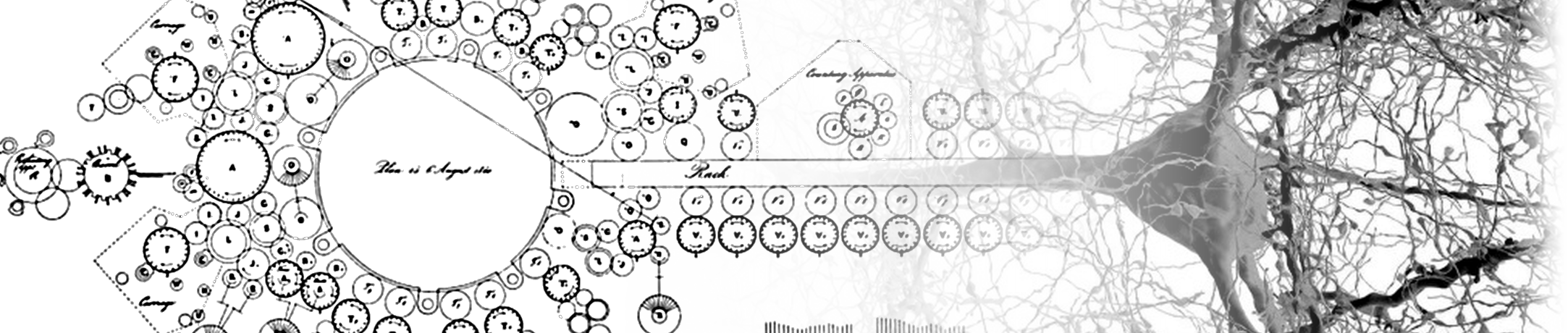


A merged illustration of Charles Babbage's mechanical calculating engine and a biological neuron, symbolizing the link between computation and cognition a new science of minds
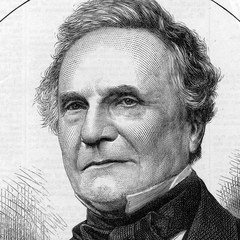
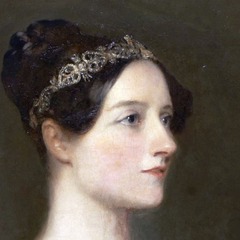
What’s this image?One of Charles Babbage's design drawings for the Analytic Engine, the profound implications of which was recognized by the visionary cognitive scientist and computer scientist Ada Lovelace. For a bit more of the history, see Patterns of Thought.Portrait of Charles BabbagePortrait of Ada Lovelace
What’s this image?A high resolution image of a single human neuron and its thousands of synaptic connections. (Your brain still has more parameters than the largest AI model). See this Nature paper.
Photo of Richard L. Lewis

Richard L. Lewis

John R. Anderson Collegiate Professor of Psychology, Linguistics and Cognitive Science

Arthur F. Thurnau Professor

University of MichiganDepartment of PsychologyDepartment of LinguisticsWeinberg Institute for Cognitive ScienceArtificial Intelligence Laboratory

Background

What’s in this background?Herb Simon's handwritten notes from 1955, working through the processing of Newell and Simon's Logic Theorist. Click here for more.

Contact rickl@umich.edu, psych.admin.staff@umich.edu

Research interests and contributions

I am a cognitive scientist and computer scientist seeking to understand the computational basis of minds, both natural and artificial. My research asks how language processing, decision making, learning, and memory are shaped by computations adapted to the constraints of minds and brains and the functional problems that they face. The work ranges from psycholinguistics to computational reinforcement learning, and involves global interdisciplinary collaborations. Most recently, I have been working with collaborators to leverage modern large language models and new AI architectures as models of human cognition, and to develop explanations of fundamental constraints on cognitive processing capacity. See my primary research contributions for more.

Recent publications and manuscripts

Capacity Limits in Cognitive Processing Reflect the Curse of Generalization

Frankland, S. M., Marjieh, R., Nurisso, M., Fluegemann, J., Webb, T., Petri, G., Lewis, R. L., & Cohen, J. D.

PsyArXiv · 2026

The striking constraints of some human cognitive processes stand in stark contrast to the near limitless capability of others. While we can acquire and flexibly use vast amounts of information, the amount we can process at any one time is often stiflingly limited: for example the number of items we can hold in working memory or the number of tasks that can be performed at once. Here, we integrate ideas from information theory, cognitive science, and neuroscience to offer a unified account of why processing is often so limited. We argue that this reflects a fundamental tradeoff between generalization -- how effectively existing representations can be used in novel settings -- and how many distinct representations can be processed in parallel. Representations that best promote strong forms of generalization -- a characteristically human cognitive strength -- come at the expense of surprisingly strict limits in the number of items that can be processed at once, an equally characteristic human weakness. We refer to this as the "curse of generalization." We formulate this first in information-theoretic terms, and then in process models, including a neural network model of classic tasks used to demonstrate strict limits in human processing capacity. This tension offers a potential explanation for a range of phenomena -- from performance on the tasks on which we focus, to representational learning and skill acquisition more broadly -- as well as the performance of modern machine learning architectures that exhibit generalization capabilities comparable to humans.More ↓Less ↑

Conflict and Congruency Effects in Large Language Models: In-Weight and In-Context Competition in a Verbal Conflict Task

Hu, X., Angstadt, M., Storks, S., Huang, Z., Taxali, A., Weigard, A., Lewis, R. L., & Sripada, C.

arXiv · 2026

Congruency effects, observed in conflict tasks such as Stroop and flanker tasks, have been investigated for nearly a century in psychology and neuroscience, but their mechanistic basis is not fully understood. We introduce a verbal-only LLM conflict task in which a prompt stem elicits a default same-color completion and an explicit rule either agrees with (congruent condition) or conflicts with (incongruent condition) the completion. Gemma-2-2B and six Pythia models ranging from 410M to 12B parameters showed strong default same-color tendencies, and six of seven models showed strong congruency effects. Using causal attribution analysis, attention analysis, and attention ablations, we identified distinct processing pathways in these LLMs: a pathway involving short-range attention to a superficial color cue that is preferentially activated in the congruent condition, and a pathway involving long-range attention to the rule prefix that is preferentially activated in the incongruent condition. Fine-tuning that strengthened the default same-color tendency had divergent effects on task conditions, reducing incongruent performance while increasing congruent performance. In contrast, increasing rule set size selectively impaired incongruent performance. These converging findings support an account in which congruency effects in this task arise from competition between an in-weight default mapping and an in-context rule-based mapping. More broadly, our findings illustrate how LLMs can serve as model systems for mechanistic analysis of competition between default and rule-governed response tendencies within a single learned network.More ↓Less ↑

Bound by semanticity: Universal laws governing the generalization-identification tradeoff

Nurisso, M., Fernando, J., Deshpande, R., Perotti, A., Marjieh, R., Frankland, S. M., Lewis, R. L., Webb, T. W., Campbell, D., Vaccarino, F., Cohen, J. D., & Petri, G.

Proceedings of the International Conference on Learning Representations · 2026

Intelligent systems must deploy internal representations that are simultaneously structured -- to support broad generalization -- and selective -- to preserve input identity. We expose a fundamental limit on this tradeoff. For any model whose representational similarity between inputs decays with finite semantic resolution, we derive closed-form expressions that pin its probability of correct generalization and identification to a universal Pareto front independent of input space geometry. Extending the analysis to noisy, heterogeneous spaces and to more than two inputs predicts a sharp collapse of multi-input processing capacity and a non-monotonic optimum for the generalization probability. A minimal ReLU network trained end-to-end reproduces these laws: during learning a resolution boundary self-organizes and empirical trajectories closely follow theoretical curves for linearly decaying similarity. Finally, we demonstrate that the same limits persist in two markedly more complex settings -- a convolutional neural network and state-of-the-art vision-language models -- confirming that finite-resolution similarity is a fundamental emergent informational constraint, not merely a toy-model artifact. Together, these results provide an exact theory of the generalization-identification trade-off and clarify how semantic resolution shapes the representational capacity of deep networks and brains alike.More ↓Less ↑
LLMs are widely regarded as alien intelligences, systems whose cognitive operations are fundamentally unlike our own. Apparent similarities to human cognition are therefore often seen as the result of anthropomorphic projection. We argue that this framing is mistaken. LLMs clearly differ from humans in important respects, including their physical substrate, learning history, and the environments with which they interact. These differences make it all the more striking that contemporary LLM-based systems converge with human cognition on a number of principles of cognitive organization with longstanding support in cognitive science. We identify structural correspondences across five dimensions: inferential organization, computational architecture, representational structure, prediction-driven learning, and reinforcement-learning-like mechanisms supporting goal-directed action. These correspondences support a broader model of intelligent cognition in which core principles long used to explain human intelligence also characterize contemporary LLM-based systems.More ↓Less ↑
Large language models (LLMs) challenge Chomsky's long-standing mysterian view of the creative aspect of language use (CALU). By exhibiting fluent, situation-appropriate linguistic behavior and offering concrete mechanistic hypotheses, they provide the first viable scientific models of CALU. We endorse Futrell and Mahowald's call to integrate LLMs into linguistic inquiry and suggest a bolder aim: elucidating the mechanisms underlying linguistic creativity.More ↓Less ↑

A brief intervention to improve reasoning about accumulation

Fansher, M., Lalwani, P., Adkins, T. J., Zhang, H., Quirk, M., Carlson, M., Boduroglu, A., Lewis, R. L., Jonides, J., & Shah, P.

Journal of Experimental Psychology: Applied · 2025

Prior research suggests that people often misunderstand visualizations of inflow (e.g., deposits in a banking context) and accumulation (e.g., cumulative savings) in dynamic systems. The present study aimed to examine participants' understanding of accumulation functions and to develop and test the effectiveness of video-based interventions for improving understanding of accumulation. In Experiment 1, we tested the effectiveness of an intervention seated in the context of understanding COVID-19 data. In Experiment 2, we addressed several limitations of Experiment 1 and developed an improved, more general intervention to teach about accumulation in contexts outside of epidemiological data. The two randomized control experiments demonstrated that people fail to understand even simple systems with a single inflow that accumulates over time, with 44%-60% of participants earning a 0% on our pretest measure. However, we also demonstrated that video-based interventions illustrating the relationship between multiple representations of the same underlying data are an effective way to improve the understanding of the relationship between inflow and accumulation, with Experiment 1 suggesting that the effects of our intervention lasted up to 6-7 weeks after testing.More ↓Less ↑