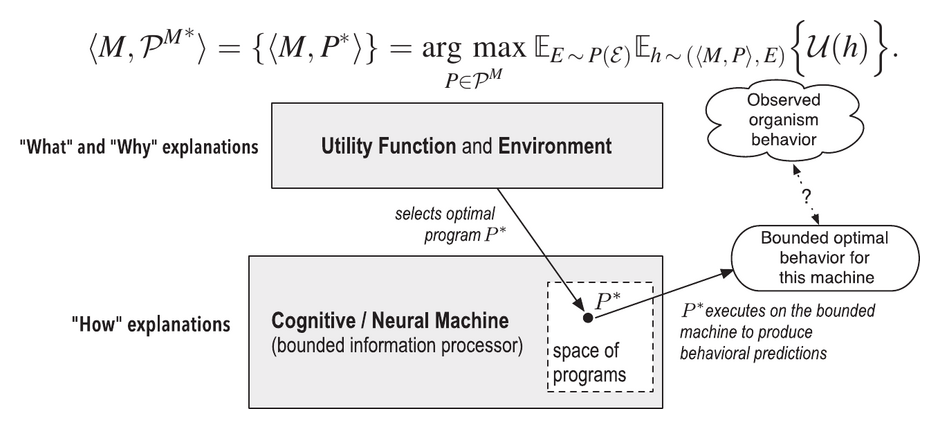
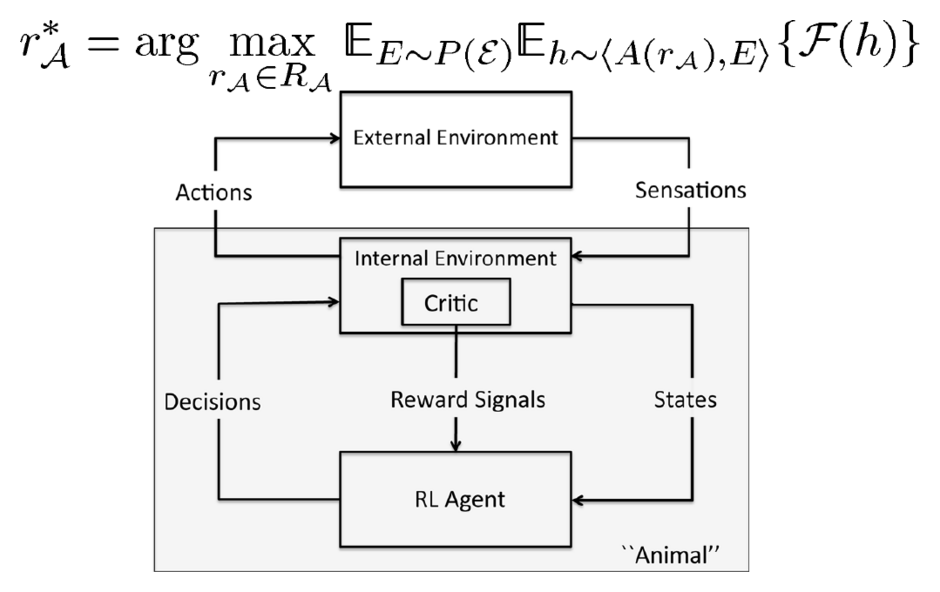
My contributions to cognitive science and AI—with many interdisciplinary collaborators—are primarily theoretical ideas and explanatory frameworks, and their application to problems in the fields. A common theme is optimization under cognitive constraints—reflected in the argmax equations below. Our recent work extends optimization explanations to the constraints themselves.
Language processing in humans and machines: Cue-based retrieval parsing and Transformers
Human language comprehension combines a striking capacity to handle long-distance linguistic relations with equally striking processing limitations, such as our inability to handle relatively shallow center-embeddings. How do we explain this dichotomy?
Click for more ↓Show less ↑
Cue-based retrieval parsing is a computational model of linguistic working memory that accounts for this dual pattern. In this model, each word triggers retrievals of representations of earlier parts of the discourse using syntactic and semantic cues. The retrievals may reach back long distances, but are subject to similarity-based interference. There is cross-linguistic evidence for such interference across multiple types of grammatical and discourse relations, including verb argument relations(Van Dyke & Lewis, 2003) and (Nakayama et al., 2006), filler-gap relations(Lewis & Vasishth, 2005), pronominal binding(Patil et al., 2016), Wh-dependencies(Obata et al., 2010), negative polarity items(Vasishth et al., 2008), and number agreement(Ryu & Lewis, 2021).
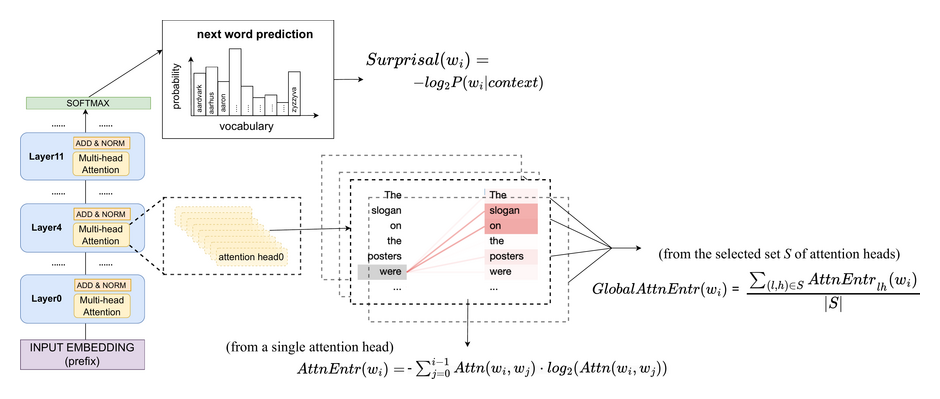
The Transformer architecture underlying most large language models is a kind of modern realization of cue-based retrieval parsing(Ryu & Lewis, 2021). Transformer attention heads retrieve relevant contextual representations via learned cues (queries), and it is possible to visualize and quantify how attention spread manifests similarity-based interference. A simple attention entropy metric quantifying this spread is predictive of word-by-word reading times, an effect that is independent of surprisal, and—surprisingly—about as large (Ryu & Lewis, 2025). We believe this is the first finding that links internal processing patterns of an LLM to human reaction times.
The cues (queries) and representations that give rise to interference are themselves the product of an optimization process (minimizing predictive loss) that is under pressure to generalize... and so there is a nascent explanation of the constraints themselves. In other work (below), we are exploring such explanations in a general way, both analytically and through simulation.
Computational rationality: Bounded optimality in cognitive science
Computational rationality is a theoretical framework for explaining how behavior is shaped by adaptation not only to the environment but to cognitive and neural constraints—e.g. memory, attention, noise, speed. More precisely, it derives behavior as the result of optimal programs running on a bounded machine (cognitive architecture) in some distribution of task environments. Computational rationality builds on Simon's bounded rationality, Anderson's rational analysis, the cognitive architecture work of Meyer, Kieras, Newell and Anderson, and the bounded optimality work of Russell and Horvig.
Click for more ↓Show less ↑
Our earliest articulation of the idea appears in Howes et al. (2009), which applied it to individual variation in dual-task performance. (Lewis et al., 2014) is a formal specification of the framework explicitly invoking bounded optimality. We have used the framework to explain phenomena in visual search(Myers et al., 2013), saccadic control in word reading (Shvartsman et al., 2014), short-term memory strategies(Howes et al., 2015), human-computer interaction(Howes et al., 2018), prospective memory(Momennejad et al., 2020), decoy effects in decision making(Howes et al., 2016) and language emergence(Bratman et al., 2010). In machine learning, we have shown that bounds on model accuracy induce finite optimal planning horizons(Jiang et al., 2015). The optimal rewards problem (below) in reinforcement learning can also be understood as a problem of bounded optimality.
For an in-depth exploration of the explanatory projects of bounded rationality, computational rationality, bounded optimality, and resource rationality, see Thomas Icard's book.
The origins of cognitive capacity constraints: The curse of generalization
The striking constraints of some human cognitive processes stand in stark contrast to the near limitless capability of others. While we can acquire and flexibly use vast amounts of information, the amount we can process at any one time is often stiflingly limited: for example the number of items we can hold in working memory or the number of tasks that can be performed at once. The empirical phenomena surrounding these limitations are some of the best-known in cognitive psychology, tracing back to George Miller's (my post-doc advisor at Princeton) famous 1956 Magical Number 7 paper (which itself summarized earlier work).
But why is the human mind and brain constrained in this way—and is it a uniquely human or biological constraint?
Click for more ↓Show less ↑
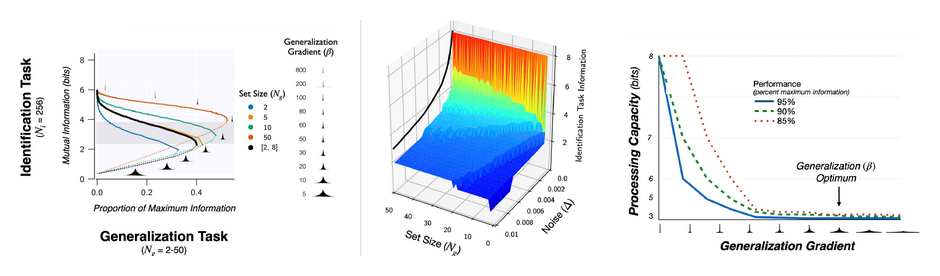
In recent work, we argue that these limitations reflect a fundamental tradeoff between generalization—how effectively existing representations can be used in novel settings, a characteristically human cognitive strength—and how many distinct representations can be processed in parallel, an equally characteristic human weakness. We refer to this as the curse of generalization.
Our work is beginning to provide the mathematical and computational foundations for understanding this tradeoff, building on information theory and related work in cognitive science, and Shepard's mathematical treatment of generalization (we dub the tradeoff the Miller-Shepard Law in honor of Miller's work on capacity constraints and Shepard's work on generalization). Furthermore, our work shows how the tradeoff is manifest in Hopfield networks(Frankland et al., 2026) and even state-of-the-art vision-language models(Nurisso et al., 2026).
The bounded rationality of human choice: Explaining context effects and patterns of risky choice
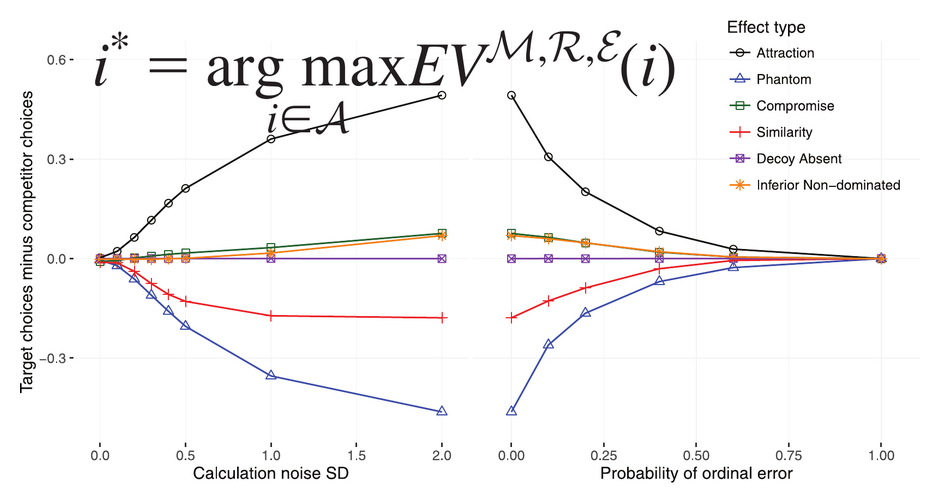
It is widely assumed that human choice is irredeemably irrational. Example: Contextual decoy effects such as the attraction, compromise and similarity effects—where the placement of an inferior option in attribute space shifts or reverses preferences between two others — are among the most replicable and well-studied effects in human decision making, and have been documented in many other organisms. They are usually taken as prima facie violations of rational choice theory: no matter how you tradeoff dimensions in choice, your preferences between two options should not be affected by attributes of a third. Why do such violations occur? It is possible to provide a rational explanation.
Click for more ↓Show less ↑
Our model of multi-attribute choice (Howes et al., 2016) challenges this conventional view, by showing that choice reversals are the behavioral signature of an expected-utility-maximizing agent with stable preferences (utilities) that is performing Bayes-optimal integration of noisy observations of attribute values and ordinal comparisons (e.g., phone A costs more than phone B, but phone B has less memory). By fitting a small number of noise parameters, the model provides quantitative accounts of all three major context effects, as well as phantom decoy effects. Under this account, preference reversals is a misnomer; they are better understood as momentary choice reversals.
Hao & Lewis (2024) demonstrated that such contextual reversals also occur in ethical choices, and presented models that explained individual variation in choice patterns as a function of variation in utilities.
In more recent work we have also shown that both preference reversals and well-known patterns of risky choice follow directly from an application of an extremely simple form of regret theory(Walls et al., 2024). Understanding the computational rationality of regret remains an open research problem.
Optimal intrinsic rewards in reinforcement learning
Key publications
Singh, S., Lewis, R. L., & Barto, A. G. (2009). Where do rewards come from?. Proceedings of the Annual Conference of the Cognitive Science Society, 2601--2606. Amsterdam.
Computational reinforcement learning provides an elegant formal framework for understanding and building goal-seeking agents, with remarkable engineering and explanatory success in AI, cognitive science and neuroscience. All RL problems start with a specification of a reward function. But where does the reward function come from?
Click for more ↓Show less ↑
The optimal reward problem provides a principled way to approach both reward function design for artificial agents and reward function explanation for biological agents. It asks, given (a) some designer's objective or an objective fitness function, (b) a distribution of environments and (c) a specific computational RL agent architecture: What is the best internal reward function to give the agent so that it maximizes the objective function in expectation in the environments? This is the bounded optimality approach to intrinsic motivation. For biological organisms, the reward is not provided externally—it is computed by the brain. For engineering, optimal rewards provides an alternative to the agent-designer practice of tweaking the details of the reward function.
What makes the optimal reward problem interesting is the impact of agent bounds—e.g. learning algorithm, memory constraints, function approximation, planning horizon—on reward design. Two agents that must maximize the same objective function but have different computational bounds may need different reward functions—a straightforward but counter-intuitive implication of the framework (see Singh et al. (2009) and Singh et al. (2010)).
We have shown how optimal rewards mitigate planning bounds(Sorg et al., 2010), induce agent specialization in multi-agent settings (Liu et al., 2012), and improve performance in deep-RL Atari game-playing agents (Guo et al., 2016). Surprisingly, we have also shown that it can be better (in terms of maximizing an objective function) to spend computational resources adapting the reward function within the agent's lifetime than spending those same resources directly maximizing the objective function itself—a strong result that we called strong mitigation of agent bounds (Bratman et al., 2012).